Loading...
Serving Walnut Creek, CA and surrounding areas. (925) 532-0252
Walnut Creek Heavy Duty Towing is your local Towing Service in Concord, CA, providing emergency towing, heavy duty recovery, and commercial towing across every part of the city - and we have been serving the Diablo Valley since 2018. Our trucks are familiar with every stretch of I-680 and Highway 4, so when a breakdown hits, we get the right equipment to you fast.
Concord is the largest city in Contra Costa County, which means more daily traffic, more breakdowns, and more moments when you need a truck on the way immediately. Our emergency towing service is available around the clock on every street and highway in Concord.
I-680 carries heavy freight through Concord's western edge every day, and Highway 4 connects the city to Pittsburg and Antioch through an industrial corridor. When a semi or big rig goes down on either route, we have the rated equipment to move it safely and legally without a second call.
Concord's postwar residential streets and commercial corridors along Willow Pass Road and Clayton Road see collisions regularly. When a vehicle ends up off the road or in a position a standard tow cannot handle, we bring winching and boom equipment to recover it without adding more damage.
Concord has a mix of retail centers, auto businesses, and service companies with large fleets operating daily. When a delivery van, cargo truck, or business vehicle goes down on a route, every idle hour costs money. We prioritize getting commercial vehicles back in service fast.
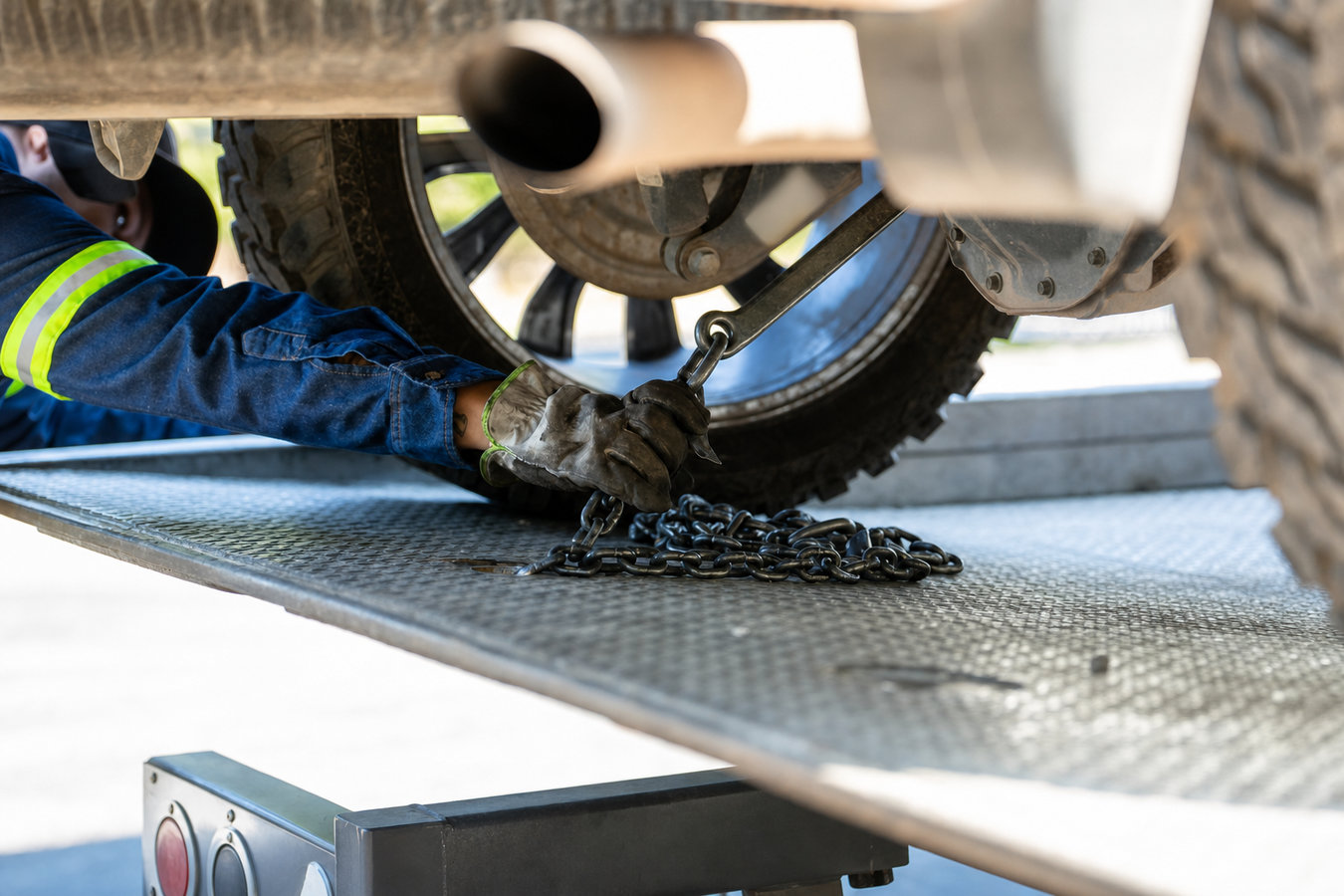
Concord's newer apartment and condo developments near the BART stations have underground and structured parking - low clearance entries and tight turns that can damage a vehicle on a standard tow. Flatbed transport lifts all four wheels and eliminates that risk entirely.
Concord's expansive clay soil swells in winter rains, and vehicles that leave the pavement on wet ground can sink in quickly - faster than trying to drive out will ever help. A winch-out pulls the vehicle back to solid ground without making the situation worse or damaging the drivetrain.
Concord is the most populous city in Contra Costa County, with roughly 120,000 to 125,000 residents spread across 30 square miles of the Diablo Valley. A large share of its housing stock was built in the 1950s through 1970s on concrete slab foundations that sit directly on the expansive clay soil underneath. That soil swells when winter rains come and shrinks in summer heat - a cycle that cracks driveways, shifts fence posts, and can leave vehicles stranded on uneven surfaces after enough years. Combine that with summer temperatures that regularly push into the 90s and above, and you get a city where vehicle breakdowns cluster predictably by season and neighborhood.
Concord also sits along one of the more seismically active corridors in the Bay Area. The Concord Fault runs close to the city, and smaller tremors are a regular part of life here. Over time, seismic activity compounds the effects of the wet-dry soil cycle, cracking older flatwork and shifting the ground under driveways in ways that create real hazards. For fleet managers and owner-operators running heavy vehicles on I-680 or Highway 4, the city's size and traffic volume also mean that a disabled vehicle creates a real traffic impact quickly - and fast dispatch matters.
Our crew works throughout Concord regularly, and we understand the local conditions that affect towing work here. The City of Concord has its own permitting and right-of-way requirements for towing operations that touch city streets, and we pull from those processes regularly. The city's postwar residential tracts - the neighborhoods built in the 1950s and 1960s on modest lots with attached garages and original concrete driveways - are where we run a significant share of our calls.
Concord is a city with a clear geography: downtown anchored by Todos Santos Plaza, commercial corridors running along Willow Pass Road and Clayton Road, residential neighborhoods spreading east toward Mount Diablo, and the two BART stations - Concord Station and North Concord/Martinez Station - that connect the city to the broader Bay Area. We know which streets get backed up during Highway 4 commute hours, where the tight apartment parking structures near the transit corridor require extra care on a flatbed, and how to reach the neighborhoods on the eastern side of the city before traffic closes in.
We regularly serve drivers coming north into Martinez on I-680 and callers from the Pleasant Hill corridor to the west. If your breakdown happens on the stretch between Concord and Walnut Creek, we cover that entire run and can dispatch to wherever you are along it.
Dispatch will ask for your exact location - nearest exit, cross street, or mile marker on I-680 or Highway 4 - your vehicle type, and what happened. Concord covers 30 square miles, so a clear location gets the right truck to you faster. You do not need to stay at the vehicle, but have a contact number available.
Before any truck rolls, we give you a clear estimate covering the base hook-up charge, mileage, and any recovery fees if winching is needed. For planned or commercial jobs, estimates come back within 1 business day. California requires transparent pricing, and we follow it.
When the driver arrives, they inspect the vehicle first - checking position, ground conditions, and safe attachment points. On Concord's older residential streets and commercial lots, the surface under a vehicle can be more uneven than it looks. This step takes a few minutes and prevents the most common cause of recovery damage.
Your vehicle goes where you direct it - your preferred shop, a dealership, or a secure storage facility. At drop-off you receive an itemized receipt that lists every charge. For insurance claims and fleet records, that receipt is the document you need.
Our dispatch is open 24 hours a day, every day - including during Highway 4 and I-680 rush-hour backups and late-night breakdowns in Concord's residential neighborhoods. Call us and we will give you an honest arrival time before we hang up.
(925) 532-0252Concord is the most populous city in Contra Costa County, with roughly 120,000 to 125,000 residents across about 30 square miles in the Diablo Valley. The city grew rapidly after World War II, and many of its neighborhoods - particularly the postwar tracts east of downtown - still have original construction from the 1950s through 1970s: single-family homes on modest lots with stucco exteriors, attached garages, and concrete driveways that are often well past their typical lifespan. Downtown Concord centers on Todos Santos Plaza, a full city-block public square known for its farmers market and community events, surrounded by restaurants and local businesses that give the area its character.
The city is framed by Mount Diablo to the southeast - visible from most of Concord on clear days - and connected to the broader Bay Area by two BART stations, which makes it a significant commuter hub. Major surface streets include Clayton Road and Concord Avenue, which run through both residential and commercial areas. The northern part of the city holds the former Concord Naval Weapons Station site, a large area still in long-term redevelopment. Concord borders Martinez to the north and Pleasant Hill to the west, and its intersection with I-680 is one of the more heavily traveled interchanges in the East Bay.
Specialized transport for heavy equipment and industrial machinery.
Learn MoreCall now for 24/7 towing and recovery anywhere in Concord - from the postwar residential neighborhoods to I-680 and Highway 4.